Peptide Screening: Hplc & Mass Specification Pureness Guide Peak
Why Hplc Purity Testing Matters For Study Peptides 2026 Without this testing, it can prove to be a lot more difficult to detect the contaminations that may be in peptide medicines. The RP-HPLC-based peptide purity evaluation solution supplied by Creative Proteomics is a lot more flexible, exact and cost-efficient. If you have needs for peptide purity evaluation services and various other associated services, please call us for consultation, and we will offer Click here to find out more you with the greatest enthusiasm. Discover flagship research peptides with batch-specific COA paperwork and HPLC/MS verification. Products are for in-vitro lab study use only and are except human usage. For peptides, HPLC divides all the molecules present in a sample, revealing whether it's made up of primarily the peptide you want-- or if there are undesirable byproducts left over from synthesis. All peptides supplied by Peptides Laboratory UK are for lab and in vitro research study usage only. Because a hydrophobic stationary phase is used, it can be utilized in combination with hydrophobic, hydrophilic, ionic and ionic substances to separate their various elements, permitting analysis to be versatile. Oxidation adjustments molecular residential or commercial properties and can change retention behavior, developing unique chromatographic heights or related mass changes. Join researchers across the UAE getting our lab-verified peptides and unique price cuts-- delivered fast and securely. When the item is authorized, the compliance pressure morphs from a concern of demonstration to a problem of maintenance. The annual item evaluation have to show that the confirmed approach continues to work as expected within its analytical guardrails; inconsistencies need restorative actions that are in turn examined. Technique transfer to a contract organisation needs side-by-side equivalence studies, because the regulatory authorities will decline a brand-new lab just asserting that it is using "the exact same" column and mobile stage. Finally, the current development of official ICH Q14 standards on logical treatment development is advertising a lifecycle technique in which recognition is no longer a single hurdle yet a living document continually refined by real-time data. Thus regulative conformity is not an outside charge grafted onto peptide scientific research; it is the official language where logical rigour is translated into client protection and industrial longevity. The location under the primary peptide optimal, compared to the complete area of all optimals, determines the purity percent. Research-grade peptides generally reveal a dominant top representing 99% or even more of the total location, with minimal contamination tops. Accurate logical recognition is important to verify peptide identity, pureness, and stability. Our services include HPLC and mass spectrometry testing to make sure that peptides meet research-grade requirements.
What Are The Standards Needed For Appropriate Quantitation During A Hplc Research?
Third-party testing removes this prejudice by presenting an external entity without any economic risk in favorable end results. Researchers can go to Optima Labs and get in the COA code to verify set authenticity and pureness in seconds. This traceable verification procedure provides full presence from synthesis to shipment.What Makes Hplc Screening Best For Dose Formula Evaluation?
In peptide research study, the top quality of your beginning products directly identifies the dependability of your outcomes. High-Performance Liquid Chromatography, frequently referred to as HPLC, is the gold conventional logical approach for evaluating peptide purity. Recognizing what HPLC testing entails and why it matters is crucial expertise for any researcher dealing with artificial peptides.Just how much does peptide HPLC screening price?
The cost of peptide evaluation solution varies significantly based on which methods your governing package needs: HPLC-UV Analysis: $& #x 24; 300 & #x 2013; & #x 24; 800 per sample (typical purity analysis) LC-MS (Fluid Chromatography-Mass Spectrometry): $& #x 24; 600 & #x 2013; & #x 24; 1,500 per sample (molecular weight verification).
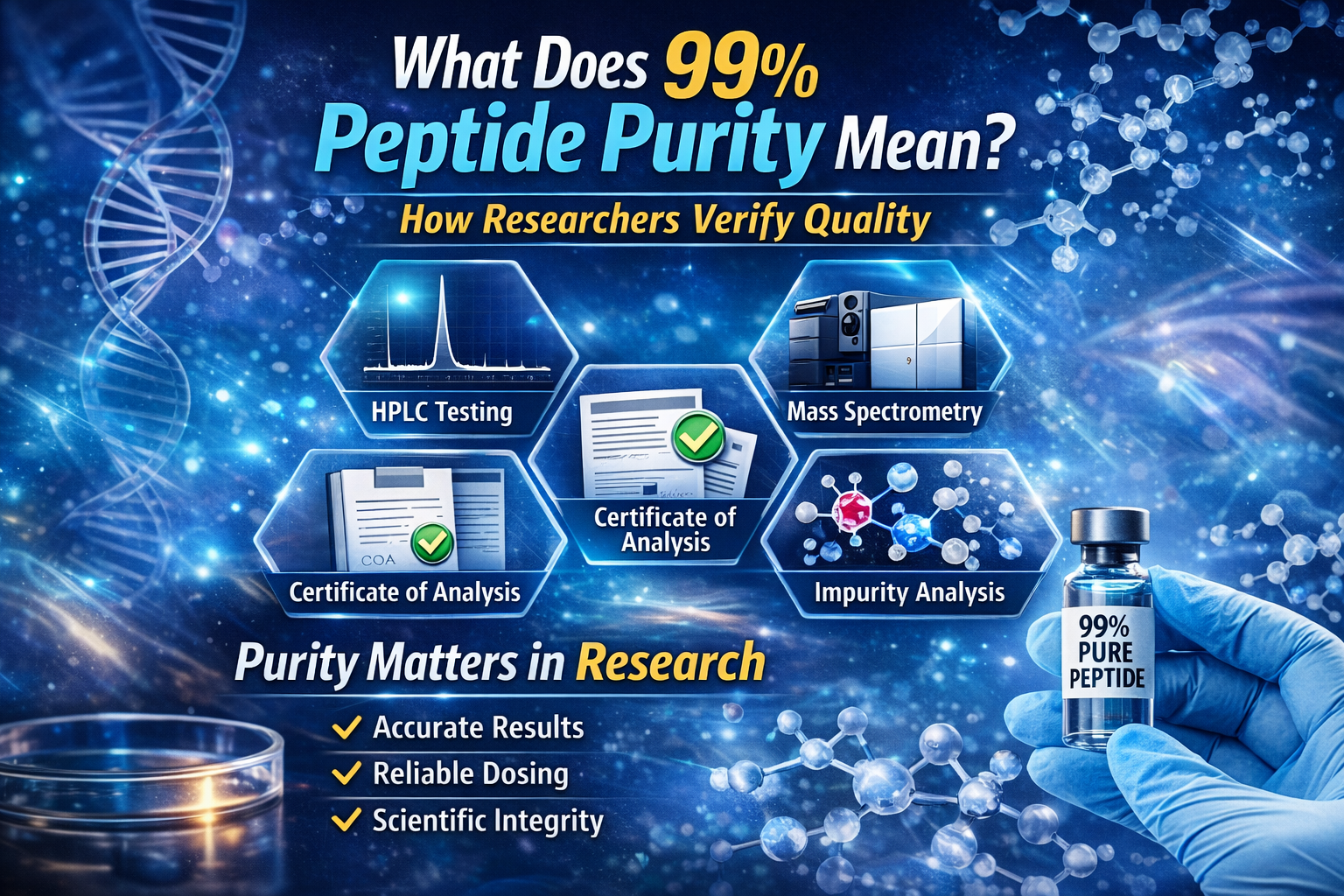
- We make use of independent third-party research laboratories for analytical testing of each batch to obtain unbiased HPLC and MS data validating the peptide's identification, purity, and structure [3]
- Researchers very closely examine HPLC results to determine if a peptide appropriates for usage.
- Ion chromatography can additionally separate ionic compounds, ion-exchange splitting up settings, and inorganic anions or cations.
- Mass Spectrometry (MS) is all about measuring the exact molecular weight of a compound.
- If your peptide consists of a benzene ring framework such as Trp, Tyr and dye molecules alterations, we can additionally make use of 275 nm as the detection wavelength for discovery as a referral.
- This batch-to-batch verification offers quality control throughout time and makes certain researchers have documentary proof for each order they position.